
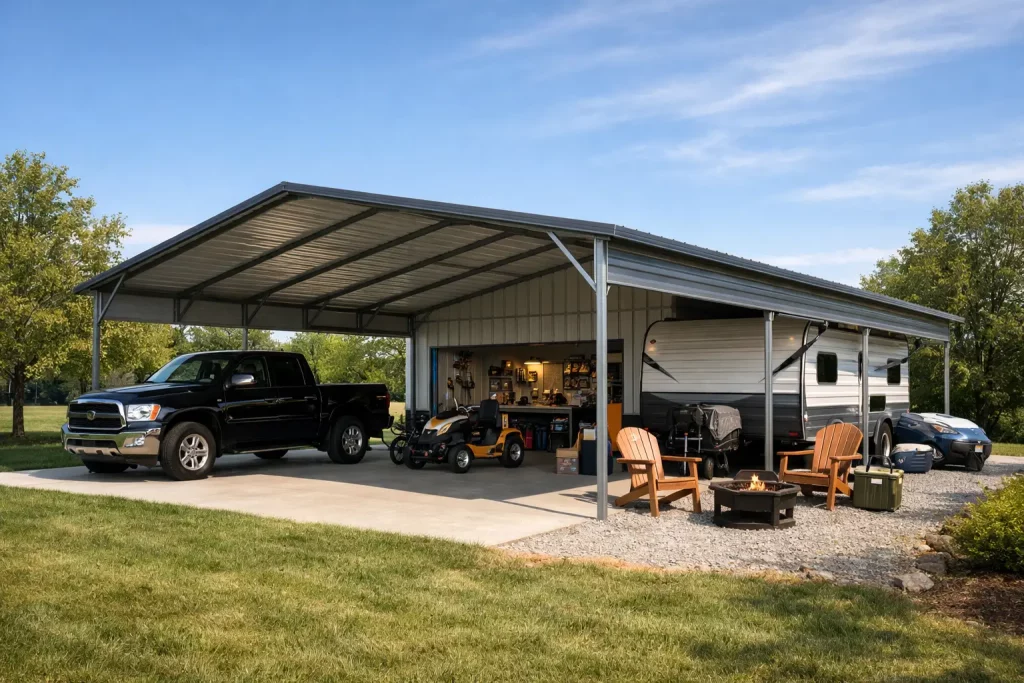
A vehicle left out in the weather takes a beating faster than most owners expect. Sun fades paint, heavy rain wears on seals, hail does obvious damage, and constant exposure adds up over time. That is why metal carports remain one of the most practical upgrades for homeowners, farmers, and business owners who need dependable protection without taking on the cost and footprint of a fully enclosed building.
A good carport does more than cover a truck or SUV. It can protect farm equipment, trailers, boats, RVs, side-by-sides, work vans, and materials that do not need four walls but do need a reliable roof overhead. For many properties, it is the fastest way to create useful covered space that starts paying off right away.
Why metal carports make sense
The main reason buyers choose steel over wood is straightforward – durability. Metal carports are built to handle long-term outdoor exposure with far less upkeep than traditional materials. When properly designed and installed, they hold up well against wind, rain, and sun while keeping maintenance simple.
They also make sense from a cost standpoint. If your goal is to protect vehicles or equipment, a carport gives you the core benefit you need without the added material and labor of a full garage. That makes it an efficient solution for property owners who want coverage now and may add enclosed space later.
Speed matters too. A carport project is typically faster to plan and install than a more complex structure. That is a major advantage if you need to cover an RV before storm season, create shaded workspace near a barn, or add customer parking coverage at a small business.
Choosing the right metal carports for the job
Not every carport is the same, and that is where buyers can either make a smart investment or end up with a structure that feels undersized from day one. The best starting point is not the building itself. It is how you plan to use it over the next several years.
If you are covering one daily driver, your needs are different from someone storing a lifted truck, fishing boat, and utility trailer in the same bay. If the structure sits near a shop or barn, you may want extra clearance for equipment movement. If it is going beside a home, appearance and roof style may matter more than they would in a back field or commercial lot.
Width, height, and length all deserve attention. Buyers often focus on width first, but height can be just as important. A standard passenger vehicle may fit comfortably under a lower roof, while a camper, RV, tractor, or enclosed trailer may require much more clearance. Planning for future use is usually the better move, especially if you already know your equipment lineup may change.
Regular roof, boxed eave, or vertical roof
Roof style affects both appearance and performance. A regular roof can work well for some basic applications, especially when budget is the top priority. A boxed eave roof gives a more traditional look that many residential buyers prefer. A vertical roof is often the strongest choice for runoff and long-term performance, particularly in areas that see heavier rain or where debris management matters.
That decision is not just cosmetic. In many situations, paying a little more for a stronger roof configuration makes sense because it improves drainage and can reduce long-term wear. It depends on your site conditions, your budget, and how hard you expect the structure to work.
Open sides or added panels
One of the biggest advantages of a metal carport is flexibility. You can keep it open for easy access and airflow, or you can add side panels, end panels, or partial enclosure for extra protection. That matters when wind-driven rain is common or when the items under the roof are more sensitive than a standard vehicle.
A fully open layout works well for quick parking, drive-through access, and equipment that needs room to move in and out. Adding panels can improve protection and make the space feel more purposeful. A partially enclosed carport often lands in the sweet spot for buyers who want better coverage without stepping up to a full garage.
Common uses beyond vehicle parking
Carports are often sold as vehicle protection first, but many property owners get more use out of them than expected. On residential lots, they can cover boats, campers, lawn equipment, and outdoor work areas. On farms, they often protect hay equipment, feeders, tractors, and implements that do not need enclosed storage year-round.
For small businesses, a carport can create covered loading space, fleet parking, or protected material staging. Contractors may use one for trailers and tool storage. Landscapers may use one to keep mowers and utility vehicles out of the weather. That kind of versatility is a big reason steel structures continue to be a strong value.
Site planning matters more than many buyers realize
A durable building still depends on a good site. Before ordering, it helps to think through placement, drainage, access, and ground conditions. A carport positioned in the wrong spot can create everyday frustration, even if the structure itself is built correctly.
You want enough room to approach, park, back out, and open doors comfortably. You also want to avoid low areas where water collects. In sloped or uneven areas, site prep may be necessary to create a stable, usable foundation. Gravel, asphalt, and concrete can all work in different scenarios, but the best choice depends on use, local conditions, and how permanent you want the installation to be.
Local permitting and code requirements should also be checked early, especially if the structure is going in a residential neighborhood or on a commercial property. In some projects, engineered options or stamped plans may be needed. That is one reason working with a provider that understands both standard buildings and more advanced code-driven projects can save time and prevent missteps.
Customization is where value really shows up
The best metal carports are rarely one-size-fits-all. Custom sizing, panel options, roof styles, color choices, and height adjustments let buyers match the building to the property instead of settling for the closest standard option.
That matters because a carport that is even a few feet too short or too narrow can become a daily problem. On the other hand, a properly sized structure can serve multiple needs at once and stay useful for years. It can start as vehicle protection and later become equipment storage, a work area, or part of a larger building plan.
For buyers who want a clearer picture before committing, using a 3D building designer can make the decision process much easier. Seeing dimensions, roof styles, and configuration options in real time helps turn abstract measurements into a practical layout that actually fits the site and use case.
Cost, maintenance, and long-term value
Price matters, but lowest upfront cost is not always best value. A cheaper structure that is undersized, lightly built, or poorly matched to the site can cost more over time in frustration, upgrades, or early replacement. It usually makes more sense to buy for the real use case instead of the minimum possible spend.
Steel is appealing because maintenance stays relatively low. You are not dealing with the same level of rot, insect damage, or repeated repainting concerns that often come with other materials. That does not mean maintenance is zero. Like any outdoor structure, it benefits from periodic inspection, keeping drainage clear, and addressing any site issues before they affect the frame or panels.
In regions that see strong storms, heavy rain, or long hot summers, long-term performance matters even more. Buyers in Tennessee and across the South often need structures that can stand up to real weather while still being installed quickly and priced competitively. That is where a well-built steel carport earns its keep.
When a carport is enough and when it is not
A carport is the right answer when your main goal is overhead protection, easy access, and efficient use of budget. It is especially useful when you want to keep vehicles, trailers, or equipment covered without needing insulation, lockable walls, or conditioned interior space.
But there are times when a carport is not enough. If you need secure storage, a workshop environment, or full weather enclosure for inventory or sensitive equipment, a garage, barn, or enclosed steel building may be the better fit. The good news is that many buyers start with a carport because it solves an immediate need and leaves room to expand later.
That practical mindset usually leads to the best outcome. Buy the structure that fits how you actually use your property, not the one that looks good on paper. If the building protects what matters, fits the site, and gives you room to work, it is doing its job well.
When you are comparing options, think less about the label and more about the function. The right covered space can protect your investment, improve day-to-day convenience, and make your property work harder without overcomplicating the project.