
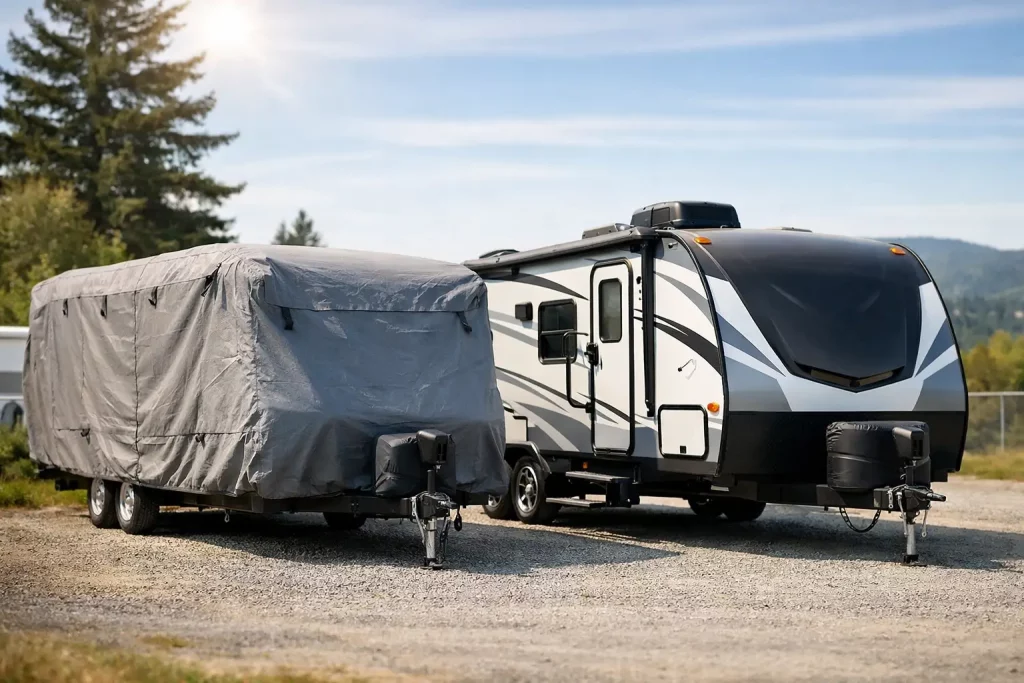
A travel trailer sitting through a full season of sun, wind, rain, and tree debris takes a beating even when it is not moving an inch. That is why owners keep asking the same question: are covers good for travel trailers, or do they create as many problems as they solve?
The honest answer is that covers can help, but only in the right conditions and only when they fit correctly, breathe well, and are used with some care. For many owners, especially those storing an RV for months at a time, a metal RV cover or roof-only structure delivers better protection, less maintenance, and fewer headaches over the long run.
Are covers good for travel trailers in real-world storage?
Fabric trailer covers exist for a reason. They can reduce direct UV exposure, keep leaves and sap off the roof, and help limit dirt buildup between trips. If your trailer is parked outdoors with no overhead protection, a quality cover is usually better than leaving the unit fully exposed.
That said, “better than nothing” is not the same as “best option.” A travel trailer cover works well when it is properly sized, secured against wind, made from breathable material, and checked regularly. If it is loose, cheap, or left unattended through rough weather, it can rub against the exterior, trap moisture, and wear faster than most owners expect.
For buyers who want practical protection and low upkeep, the bigger question is not just whether a cover works. It is whether it works well enough for your storage conditions.
What a trailer cover does well
The strongest argument for a fabric cover is straightforward. It creates a barrier between the trailer and the elements.
Sun exposure is one of the biggest long-term threats to RV exteriors. UV rays dry out seals, fade graphics, and add wear to rubber and plastic components. A cover helps reduce that constant exposure. It also keeps off bird droppings, pollen, acorns, and the grime that builds up when a trailer sits for weeks or months.
In mild climates or sheltered storage areas, that may be enough. If your trailer is parked on a property without a garage or permanent structure, a well-made cover can be a reasonable short-term solution. It is also portable, which appeals to owners who are not ready to invest in a fixed structure.
For occasional use, especially in off-season storage, a fabric cover has a clear place. It can extend the time between cleanings and help preserve exterior finishes if used correctly.
Where trailer covers fall short
The problems start when buyers expect a fabric cover to perform like a permanent protective structure. It does not.
Wind is the biggest issue. Even a secured cover can shift and flap, and that repeated movement can scuff paint, wear decals, and create abrasion points on corners and edges. Over time, the very thing meant to protect the trailer can start causing cosmetic damage.
Moisture is another concern. Many covers are marketed as breathable, but real-world performance depends on climate, ventilation, fit, and installation. If moisture gets trapped underneath, you can end up with mildew, staining, or problems around seals and roof components. In humid Southern conditions, that risk is not small.
There is also the hassle factor. Installing and removing a large trailer cover is not a quick job, especially on taller units. You are climbing ladders, working around sharp edges, tightening straps, and checking fit. Then you need to inspect it after storms, clean it, store it when not in use, and eventually replace it when the material breaks down.
That replacement cycle matters. A fabric cover may cost less upfront, but it is still a consumable product. Sun, wind, and weather wear it down. If you are buying a new one every few years, the value equation changes.
Are covers good for travel trailers year-round?
For year-round outdoor storage, fabric covers are often a compromise, not a complete solution.
If your trailer sits under heavy sun for most of the year, or if your property sees frequent storms, strong winds, ice, or falling debris, a soft cover has limits. It may protect the surface from some exposure, but it will not stop branches, hail impact, or water blowing in from every direction. It also will not give you much convenience when you want to access the RV quickly.
Owners who use their trailer often run into another issue. Repeatedly covering and uncovering the unit becomes a chore, so the cover ends up being used less than planned. That means the trailer spends more time exposed anyway.
For long-term, full-time storage, especially on residential land, farms, or business property, a metal RV cover tends to make more sense. It gives you overhead protection every day without touching the trailer exterior.
Why a metal RV cover is often the better option
A steel RV cover solves the biggest weaknesses of a fabric cover by changing the approach entirely. Instead of wrapping the trailer, it shields it from above with a durable structure designed for weather resistance and long service life.
That means no fabric rubbing against the sides. No climbing up to wrestle with straps before and after trips. No folding up a wet cover and figuring out where to store it. The trailer stays accessible while still protected from direct sun, rain, and falling debris.
For many owners, the real value is consistency. A properly built metal RV cover provides day-to-day protection without adding maintenance to your routine. That matters if you use your trailer regularly or want a cleaner, more dependable storage setup on your property.
It also gives you more flexibility. You can size the structure for the trailer you have now and allow room for slide-outs, height clearance, tow vehicle access, or future upgrades. Some owners prefer a roof-only cover for affordability and airflow, while others add partial or enclosed sides for more protection.
That level of customization is hard to match with a universal fabric cover.
When a fabric cover still makes sense
There are situations where a standard trailer cover is a practical choice.
If you are storing a trailer temporarily, working within a tight budget, or keeping the unit in a relatively sheltered area, a quality fabric cover may do the job well enough. It can also help if your HOA, site layout, or short-term plans make a permanent structure unrealistic right now.
The key is buying the right cover and using it correctly. Fit matters. Breathability matters. Regular inspection matters. A bargain cover that tears, pools water, or shifts in the wind is not much of a bargain.
Think of a fabric cover as a useful layer of protection, not a one-and-done storage solution.
How to decide what is right for your trailer
Start with how often the trailer sits and what kind of weather it faces. If it is parked outdoors for extended stretches and exposed to strong sun, frequent rain, or storm activity, a metal RV cover is usually the smarter long-term investment.
Next, consider your tolerance for maintenance. If you do not want to wrestle with a fabric cover, monitor it after wind events, and replace it every few seasons, a steel structure offers a much simpler ownership experience.
Then look at cost through a longer lens. A fabric cover often wins on initial price. A metal cover often wins on durability, convenience, and long-term value. For property owners who plan to keep their RV for years, that difference matters.
Finally, think about the site itself. If you have the space for a properly sized RV cover, you can create a more functional setup that protects the trailer and improves access at the same time. That is especially useful for homeowners, farms, and rural properties where equipment protection is part of everyday planning.
The better question to ask
Instead of asking only whether covers are good for travel trailers, ask what kind of cover gives you the protection, convenience, and lifespan you actually need.
A fabric cover can help in the right setting. But if you want reliable weather protection, easier access, and a storage solution that does not wear out like a seasonal accessory, a metal RV cover is often the stronger answer. When your trailer is an investment, protecting it with a structure built for the long haul usually pays off where it counts – condition, usability, and peace of mind.
If your goal is simple, dependable protection, choose the option that works every day, not just the one that costs less on day one.