
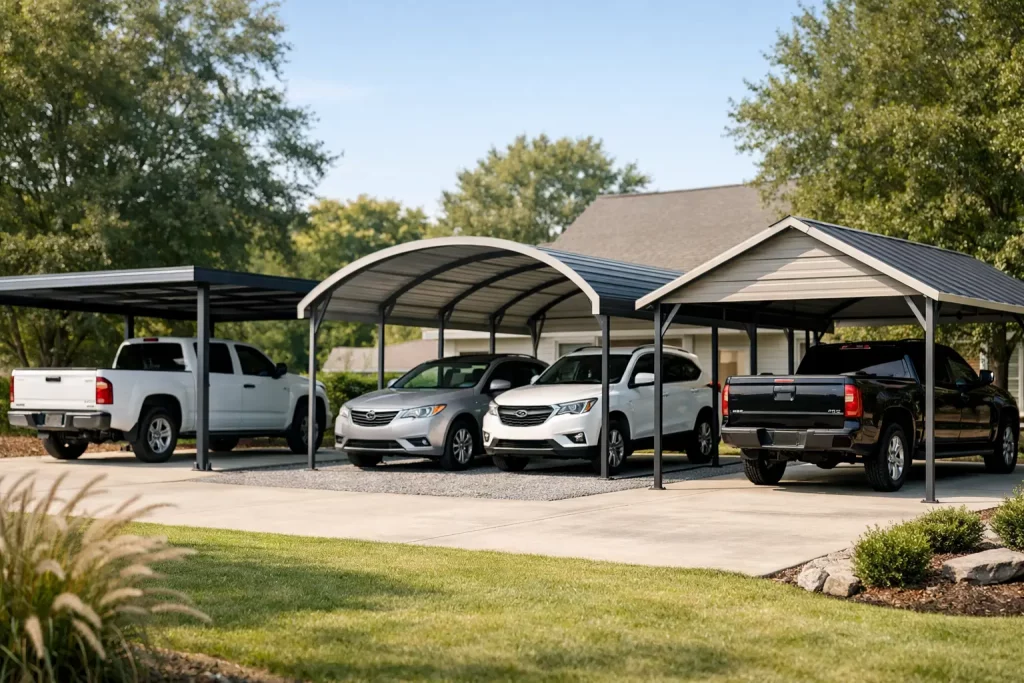
A carport roof does more than determine how the building looks from the driveway. It controls where rainwater goes, how well the structure handles wind, how much clearance you have for vehicles, and how easily the cover fits beside an existing home, barn, or shop. Knowing how to choose carport roof style starts with the property itself, not simply the style you prefer in a photo.
For Middle Tennessee property owners, roof choice deserves extra attention. Heavy rain, seasonal storms, humidity, falling leaves, and occasional snow all affect how a carport performs over time. The right roof style gives you dependable protection for vehicles and equipment while keeping drainage, access, and installation practical.
Start With What the Carport Must Protect
A compact carport for one passenger vehicle has different roof needs than a tall RV cover, farm equipment shelter, or commercial vehicle canopy. Begin by measuring the overall width, length, and height of what will sit beneath the roof. Include mirrors, trailers, roof racks, open doors, and the turning room needed to pull in comfortably.
Height is especially important when selecting a roof profile. A taller roof may give you better access for trucks, campers, tractors, or enclosed trailers, but it also creates more surface area for wind to act on. That does not make a tall carport a poor choice. It means the frame, anchors, roof orientation, and site conditions need to be planned as a system.
Think beyond today’s vehicle as well. A carport often becomes the place for an additional truck, a boat, an ATV trailer, hay equipment, or seasonal storage. If the structure needs to serve multiple uses, a wider or taller roof configuration may offer better long-term value than buying to the bare minimum dimensions.
The Main Carport Roof Styles to Consider
Most metal carports fall into three common roof categories: regular roof, boxed-eave roof, and vertical roof. Each can provide useful vehicle protection, but they differ in appearance, drainage, and performance.
Regular Roof: A Cost-Conscious Option
A regular roof has rounded corners and horizontal roof panels that run from front to back. It is often the most economical choice for a basic carport, especially when the building is smaller and the site has minimal exposure to trees or heavy runoff.
The trade-off is water management. Because the panels run horizontally, rainwater and debris move across the ribs rather than directly down the length of the roof. On a clear, open site, that may be perfectly workable. Under mature trees or in an area that sees frequent heavy rain, it can require more routine cleaning to prevent leaves and debris from collecting.
A regular roof can be a practical fit for a budget-focused vehicle cover where appearance and advanced drainage are not the primary concerns. It is less ideal when the carport will be highly visible, attached near a finished home, or expected to protect valuable equipment with minimal maintenance.
Boxed-Eave Roof: A More Finished Look
A boxed-eave roof uses a cleaner, more traditional roofline with trim along the eaves. Like a regular roof, its panels typically run horizontally, but the finished appearance makes it a popular choice for residential properties.
This style works well when curb appeal matters and the carport needs to complement a house, detached garage, or workshop. It can also be a solid choice for straightforward vehicle storage on a site with ordinary drainage needs.
Its limitation is similar to the regular roof: horizontal panels do not shed water and debris as efficiently as vertical panels. If your property is open, the roof is easy to access, and you are comfortable with occasional upkeep, a boxed-eave carport provides a good balance of function and visual appeal.
Vertical Roof: Built for Drainage and Lower Maintenance
A vertical roof has panels that run from the ridge down toward the eaves. This allows rain, snow, leaves, and other debris to move off the roof more efficiently. Vertical roof systems also include added framing components that support the panel orientation, making them a stronger long-term choice for many larger or more exposed carports.
For a carport in Middle Tennessee, a vertical roof is often the best fit when the building is long, tall, located near trees, or intended for valuable vehicles and equipment. It is particularly useful for RV covers, boat storage, agricultural equipment shelters, and commercial parking canopies where drainage and reduced maintenance matter.
Vertical roofing usually costs more than regular or boxed-eave options. The added investment is often justified by better water flow, a more polished appearance, and fewer issues with debris sitting across the roof panels. If the building will be in place for many years, this is usually the roof style worth comparing first.
How to Choose Carport Roof Style for Your Site
The site often makes the decision clearer. Before choosing a roof style, look at slope, drainage paths, surrounding structures, tree cover, and prevailing weather exposure. A carport that looks right on a level, open lot may need a different configuration on a narrow driveway or a sloped rural property.
If water already pools near the planned location, fix the drainage issue before installation. A roof can direct water away from the vehicle bay, but it cannot solve poor grading by itself. Consider where runoff will land once it leaves the eaves. You do not want roof water draining toward a foundation, walkway, entry door, or area that turns muddy after storms.
Orientation matters too. In many cases, positioning the roof so water sheds away from buildings and traffic paths improves everyday usability. For a carport placed beside a home or shop, confirm there is enough room for runoff, gutters if needed, and access for maintenance.
Tree cover is another deciding factor. A regular or boxed-eave roof beneath pines, oaks, or other heavy-dropping trees can collect needles, leaves, acorns, and small limbs. A vertical roof does not eliminate maintenance, but it helps debris travel off the roof instead of remaining on it. If relocating the carport is not an option, investing in vertical panels can save time over the life of the structure.
Match the Roof Profile to Nearby Buildings
A carport does not need to exactly match your home to look appropriate, but it should feel intentional. Roof pitch, trim color, panel color, and eave style all affect how the building fits the property.
A boxed-eave roof often complements traditional residential architecture because it has a more finished edge. A vertical roof has a clean, substantial appearance that fits well beside metal shops, barns, garages, and larger rural buildings. For agricultural and commercial properties, performance may matter more than matching details, but color coordination can still create a more professional result.
Do not choose a lower roof merely because it looks less noticeable. Adequate clearance and usable coverage are more valuable than a roofline that disappears into the background. A properly sized carport protects the vehicle without forcing drivers to squeeze around posts or worry about roof contact.
Consider Wind, Anchoring, and Local Requirements Early
Roof style is only one part of a durable carport. The frame gauge, leg spacing, bracing, anchor type, and installation surface all contribute to how the building performs. An open, elevated, or storm-exposed site may require stronger engineering and anchoring than a sheltered location.
Ground conditions matter as well. A carport can be installed on concrete, gravel, asphalt, or ground depending on the project, but each surface requires the right anchor approach. Concrete offers a clean, stable base for many vehicle covers. Gravel can be a cost-effective option for rural equipment storage when the pad is properly prepared and drainage is addressed.
Some locations, subdivisions, and commercial sites may have setback, appearance, permit, or wind-load requirements. Check those details before finalizing dimensions or ordering. For larger structures, tall RV covers, enclosed additions, or projects with code-driven needs, engineered options and stamped plans may be appropriate.
Build for Maintenance You Can Actually Keep Up With
Every metal carport needs periodic inspection. Check fasteners, remove debris, keep the area around posts clear, and watch for drainage changes after major storms. The roof style you choose should reflect how much upkeep is realistic for your property.
If you want the lowest upfront cost for a simple, accessible cover, regular roofing may meet the need. If appearance is a priority and the site is relatively clear, boxed eave is a strong middle option. If you want better drainage, less debris accumulation, and a roof built for long-term use, vertical roofing is usually the most practical investment.
A carport should make daily life easier, not create a new maintenance problem. Taylor Wilson Steel can help you compare roof styles, dimensions, colors, and anchoring options so the final structure suits your site, vehicles, and future plans from the start.